
Solar Panels for Scottish Businesses: Costs, Savings and Tax Benefits
November 4, 2026 | 14d | Blog
Solar Panels for Scottish Businesses: Costs, Savings and Tax Benefits
For many Scottish businesses, commercial solar panels can reduce electricity costs, protect against future energy price increases and potentially provide valuable tax relief on the cost of installation.
Businesses are particularly well suited to solar because many use most of their electricity during the daytime – exactly when solar panels are generating.
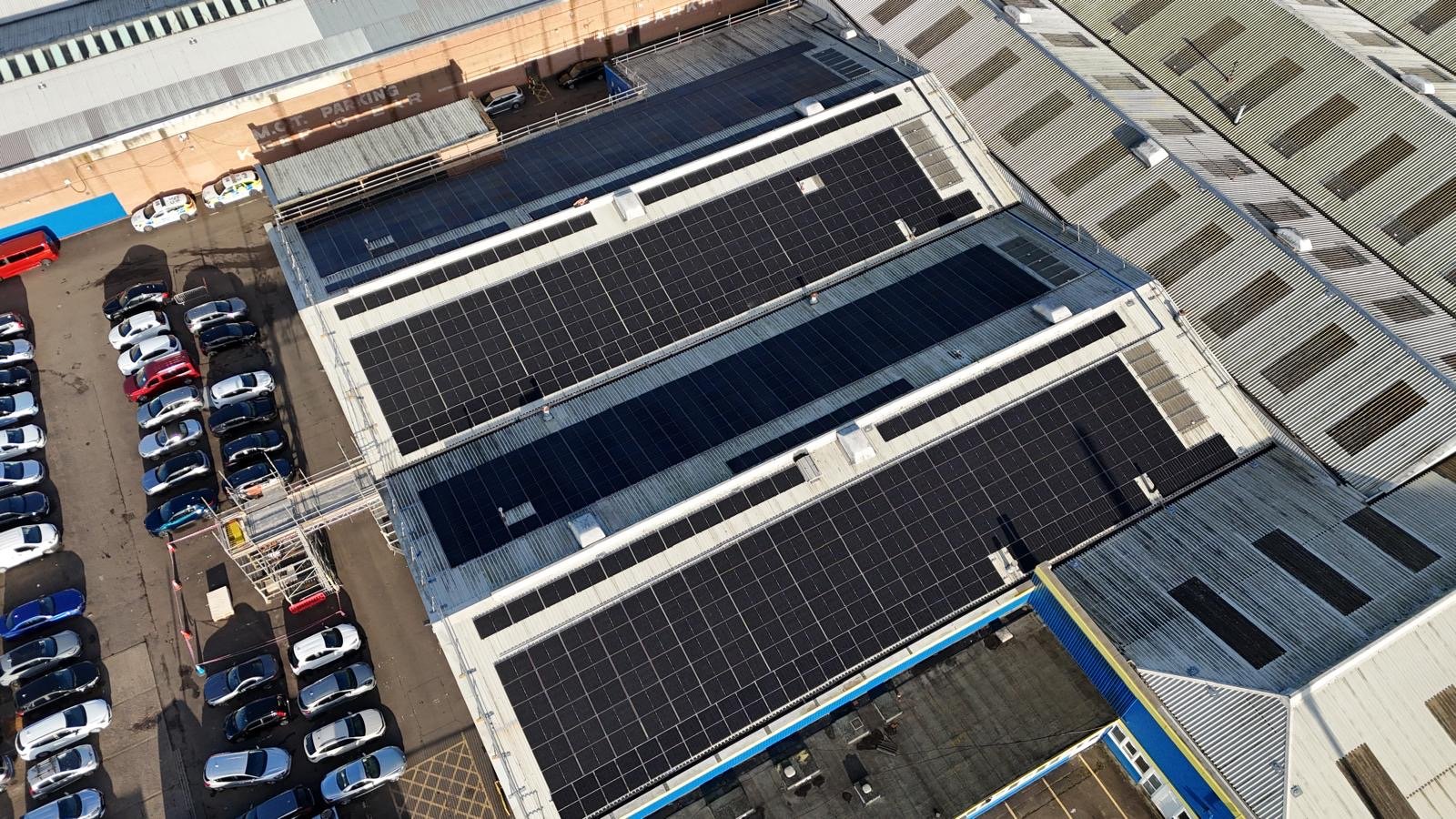
Warehouses, factories, offices, farms, retail units, hotels, leisure facilities and other commercial properties can all potentially turn unused roof space into an electricity-generating asset.
But how much do commercial solar panels cost in Scotland? How much can a business save? How long do they take to pay back? And what tax relief is available?
Here is what Scottish businesses need to know in 2026.
Are solar panels worth it for businesses in Scotland?
Solar panels can make strong financial sense for Scottish businesses with suitable premises and significant daytime electricity consumption.
The basic reason is simple.
Without solar, your business buys electricity from the grid.
With solar, some of that electricity can be generated on your own roof instead.
Every unit of solar electricity that your business generates and uses on-site is a unit that you do not need to purchase from your electricity supplier.
The more solar electricity you can use within the business, the stronger the financial return is likely to be.
Commercial solar can help businesses:
- reduce electricity purchased from the grid;
- reduce exposure to volatile commercial energy prices;
- make productive use of unused roof space;
- reduce carbon emissions;
- support environmental and sustainability targets;
- generate income from eligible surplus electricity;
- support EV charging and battery storage; and
- potentially benefit from capital allowances on the installation cost.
How much do commercial solar panels cost in Scotland?
Commercial solar installations in 2026 can broadly range from around £850 to £1,300 per kWp for many straightforward rooftop projects, excluding VAT, although every installation needs to be individually priced.
Larger systems will often cost less per kWp than smaller installations because costs such as design, scaffolding, grid applications, project management and commissioning are spread across a larger solar array.
As an indicative guide:
| Example system size | Indicative commercial solar cost |
|---|---|
| 30 kWp | Approximately £33,000–£40,000 |
| 50 kWp | Approximately £50,000–£65,000 |
| 100 kWp | Approximately £85,000–£105,000 |
| 250 kWp | Approximately £190,000–£240,000 |
These are indicative 2026 planning figures rather than quotations.
The actual cost of a commercial solar system depends on factors including:
- the size of the installation;
- roof type and condition;
- roof access;
- structural requirements;
- scaffolding or lifting requirements;
- the solar panels and inverters selected;
- electrical infrastructure on site;
- cable runs;
- grid connection requirements;
- whether battery storage is included; and
- whether additional electrical or building work is required.
The UK Government also publishes official solar PV cost data for smaller installations, although larger commercial projects should always be assessed and quoted individually.
How much can a Scottish business save with solar panels?
The amount your business can save depends largely on two things:
- how much electricity the system generates; and
- how much of that electricity your business uses itself.
Using solar electricity on-site is normally more valuable than exporting it because it replaces electricity that you would otherwise have bought from your supplier.
This is one of the reasons commercial properties can be particularly well suited to solar.
An office, factory or warehouse may consume large amounts of electricity between 8am and 6pm – the same period when a solar PV system is producing most of its electricity.
An example commercial solar calculation
Imagine a Scottish business installs a 100kWp solar system.
For illustration, suppose the system generates approximately 90,000kWh of electricity in a year.
If the business uses 75% of that electricity on-site:
- 67,500kWh is used by the business;
- 22,500kWh is exported; and
- the business buys 67,500 fewer kWh from its electricity supplier.
If the electricity being replaced costs 25p per kWh, the electricity used on-site would be worth approximately:
67,500kWh × £0.25 = £16,875 per year.
If the remaining 22,500kWh was exported at an illustrative rate of 5p per kWh:
22,500kWh × £0.05 = £1,125 per year.
That would create an illustrative annual financial benefit of around:
£18,000 per year.
This example is deliberately simplified. Actual generation, electricity prices, export rates, system performance, maintenance and consumption patterns will all affect the return.
How long do commercial solar panels take to pay for themselves?
Many commercial solar projects are currently modelled with simple payback periods of approximately four to eight years, although some installations can be faster or slower.
A business that operates seven days a week and consumes large amounts of electricity during daylight hours may achieve a considerably stronger return than a property which is mostly empty during the day.
Payback is affected by:
- the cost of the installation;
- annual solar generation;
- the proportion of generation used on-site;
- your current commercial electricity tariff;
- future electricity prices;
- export income;
- maintenance costs;
- financing costs; and
- available tax relief.
Commercial solar panels are designed to generate electricity for decades, so a system that achieves payback within the first part of its operating life can continue producing financial savings long after the initial investment has been recovered.
What tax relief is available for commercial solar panels?
Commercial solar installations can potentially qualify for capital allowances, allowing businesses to deduct qualifying expenditure from taxable profits.
However, the exact tax treatment depends on your business structure, the equipment purchased and your individual tax position.
This is an area where businesses should always confirm their position with their accountant or tax adviser.
Can solar panels qualify for the Annual Investment Allowance?
Yes. Solar panels can generally qualify as plant and machinery for capital allowance purposes, and eligible businesses may be able to use the Annual Investment Allowance.
The Annual Investment Allowance – commonly called AIA – currently allows businesses to deduct up to £1 million of qualifying plant and machinery expenditure from their taxable profits.
This can potentially provide a 100% deduction in the accounting period in which the qualifying expenditure is incurred.
For example, if a company spends £100,000 on a qualifying commercial solar installation and has sufficient AIA available, it may potentially deduct the £100,000 qualifying expenditure from profits before calculating Corporation Tax.
The resulting tax saving depends on the company's circumstances and effective Corporation Tax rate.
You can read the current HMRC rules on the Annual Investment Allowance on GOV.UK.
Can a business claim 100% full expensing on solar panels?
This is where commercial solar tax advice is often oversimplified.
Solar panels are specifically treated by HMRC as special-rate plant and machinery.
That means solar panels do not generally qualify for the standard 100% full-expensing allowance that applies to qualifying main-rate plant and machinery.
However, this does not mean businesses cannot receive 100% upfront tax relief.
Where a business has sufficient Annual Investment Allowance available and the expenditure qualifies, the AIA can potentially provide a 100% deduction instead.
For limited companies that do not use AIA for the expenditure, new and unused qualifying special-rate plant and machinery may potentially qualify for the 50% special-rate first-year allowance, with the remaining balance entering the special-rate capital allowance pool.
HMRC specifically lists solar panels as special-rate assets.
Always speak to your accountant before making an investment based on expected capital allowances.
How much Corporation Tax could commercial solar save?
The Corporation Tax benefit depends on the company's profits and tax rate.
For the 2026/27 financial year:
- the main Corporation Tax rate is 25% for companies with profits above the upper threshold;
- the small profits rate is 19%; and
- companies between the relevant thresholds may receive Marginal Relief.
As a simple illustration, imagine a profitable company incurs £100,000 of qualifying solar expenditure and can claim the full £100,000 through AIA.
If that deduction effectively saves Corporation Tax at 25%, the potential Corporation Tax reduction would be:
£100,000 × 25% = £25,000.
That does not mean HMRC pays £25,000 towards the installation.
It means the qualifying capital allowance may reduce the company's taxable profits, potentially reducing its Corporation Tax bill by that amount depending on its individual tax position.
Businesses with different profits, associated companies, losses or other allowances may receive a different benefit.
Is VAT charged on commercial solar panels?
Commercial solar installations will normally be subject to the standard 20% VAT rate.
This is different from the temporary VAT relief available on qualifying domestic installations.
However, a VAT-registered business can generally reclaim VAT paid on goods and services purchased for its taxable business activities, subject to the normal VAT rules.
For example, if a commercial solar installation costs £100,000 plus £20,000 VAT, an eligible VAT-registered business may normally be able to recover the £20,000 input VAT through its VAT return.
There can be complications for businesses making VAT-exempt supplies, partly exempt businesses and businesses using equipment for both business and non-business purposes.
HMRC's guidance on reclaiming VAT on business expenses explains the general rules.
Can businesses get paid for exporting solar electricity?
Yes. Eligible businesses with solar PV can potentially receive payment for electricity exported to the grid.
The Smart Export Guarantee applies to eligible renewable electricity generators in Great Britain, including businesses.
Solar PV installations of up to 5MW can potentially qualify, subject to the scheme requirements.
Export tariff suppliers set their own:
- payment rates;
- contract lengths; and
- other tariff conditions.
Ofgem requires eligible Smart Export Guarantee tariffs to pay more than zero for exported electricity.
You can find more information through Ofgem's Smart Export Guarantee guidance.
For most businesses, however, the strongest return generally comes from using as much solar electricity on-site as possible rather than designing a system primarily for export.
Is there a commercial solar grant for Scottish businesses?
There is not currently a universal solar grant available to every Scottish business.
Funding schemes change regularly and eligibility can depend on business size, location, sector and the technology being installed.
Importantly, Business Energy Scotland currently states that its SME Loan Scheme is not accepting new applications for solar PV projects.
Businesses should therefore be wary of marketing that suggests every Scottish company can automatically receive a government grant towards solar.
There may still be other funding opportunities, finance products or local schemes available depending on the project.
Businesses can check current support through Business Energy Scotland.
Can commercial solar be financed instead of purchased outright?
Yes.
Businesses do not always need to fund the full installation from existing cash reserves.
Depending on the project, commercial solar may potentially be funded through:
- cash purchase;
- asset finance;
- commercial loans;
- hire purchase;
- leasing arrangements; or
- Power Purchase Agreement-style structures.
The best approach depends on the business's cash position, tax position, cost of finance and long-term plans for the premises.
Businesses considering finance should compare the total financing cost with the expected electricity savings rather than looking only at the monthly repayment.
Do commercial solar panels affect business rates in Scotland?
Businesses should not assume that installing rooftop solar automatically creates a business rates discount.
Scotland does have Renewable Energy Relief within the non-domestic rates system for qualifying properties solely concerned with producing heat or power from eligible renewable technologies, including photovoltaics and solar power.
However, this does not mean an ordinary warehouse, office, factory or retail unit automatically qualifies simply because solar panels are installed on the roof.
The rating treatment depends on the property and circumstances.
Businesses should confirm any non-domestic rates implications with the relevant Scottish assessor or professional adviser before relying on a rates saving in their financial model.
Do commercial solar panels need planning permission in Scotland?
Many rooftop solar installations on non-domestic buildings in Scotland can be carried out under permitted development rights, but there are important exceptions.
Current Scottish permitted development rights allow solar PV and solar thermal equipment to be installed on many non-domestic buildings without a full planning application.
However, permitted development rights may not apply in certain circumstances, including:
- listed buildings or buildings within their curtilage;
- certain installations in conservation areas;
- sites close to an aerodrome or technical site;
- National Scenic Areas;
- National Parks;
- World Heritage Sites;
- historic gardens and designed landscapes; or
- installations exceeding the relevant dimensional limits.
Ground-mounted commercial solar and solar carports have their own planning rules.
You can find current guidance in the Scottish Government's non-domestic solar permitted development guidance.
Can I install solar if my business rents its premises?
Potentially, yes.
Businesses do not necessarily need to own the building to benefit from commercial solar.
However, tenants will normally need to consider:
- landlord consent;
- the remaining length of the lease;
- who owns the solar equipment;
- roof maintenance responsibilities;
- what happens to the system when the lease ends;
- dilapidation obligations; and
- whether the investment can realistically pay back during the occupation period.
A long-term tenant with substantial electricity use may still have a strong financial case for solar, but the lease position should be reviewed before proceeding.
What types of Scottish businesses benefit most from solar?
Commercial solar is particularly attractive where electricity consumption is high during daylight hours.
This can include:
- manufacturing businesses;
- warehouses and distribution centres;
- engineering companies;
- farms and agricultural businesses;
- offices;
- retail units;
- hotels;
- leisure centres and gyms;
- care facilities;
- schools and educational buildings;
- vehicle dealerships;
- food and drink manufacturers; and
- businesses charging electric vehicles during the day.
A large roof alone does not make a business an ideal solar candidate.
The strongest projects combine suitable roof space with high daytime electricity demand.
Can solar panels be combined with commercial battery storage?
Yes.
Commercial batteries can store electricity generated by solar panels for use later rather than exporting it immediately.
Battery storage can potentially help businesses:
- increase solar self-consumption;
- reduce evening grid imports;
- make better use of time-of-use tariffs;
- manage peak electricity demand;
- support EV charging; and
- provide additional energy-management flexibility.
However, battery storage adds significantly to the capital cost of a project and does not automatically improve financial payback.
A battery should therefore be sized around the business's electricity profile rather than simply added to every solar installation.
Can businesses use solar panels to charge electric vehicles?
Yes.
Solar and EV charging can work particularly well together for businesses with vehicles parked at their premises during daylight hours.
Electricity generated by the solar array can contribute towards charging:
- company cars;
- electric vans;
- fleet vehicles;
- employee vehicles; and
- customer vehicles.
This can allow a business to replace some grid electricity – and potentially some petrol or diesel consumption – with electricity generated from its own property.
Solar carports can also provide an option where roof space is unsuitable or where businesses want to combine covered parking with solar generation and EV charging infrastructure.
What size solar system does my business need?
There is no standard commercial solar system size.
The right system should be based on:
- annual electricity consumption;
- half-hourly electricity usage where available;
- daytime demand;
- available roof area;
- roof orientation;
- shading;
- structural capacity;
- grid connection limitations;
- future EV charging requirements;
- future electrification of heating or machinery; and
- whether battery storage is planned.
For commercial solar, electricity consumption data is particularly valuable.
Half-hourly meter data allows an installer to compare when your business uses electricity against when the proposed solar system is expected to generate.
This makes it possible to estimate self-consumption and financial savings much more accurately.
What is the best way to calculate commercial solar ROI?
A proper commercial solar proposal should include more than the number of panels that fit on the roof.
Businesses should ask for information including:
- total system size in kWp;
- predicted annual generation in kWh;
- estimated percentage of electricity used on-site;
- estimated exports;
- current electricity cost assumptions;
- annual savings;
- potential export revenue;
- estimated payback period;
- equipment warranties;
- expected panel degradation;
- maintenance requirements;
- grid connection assumptions; and
- any tax assumptions included in the financial model.
Be particularly cautious of commercial solar proposals that promise extremely short payback periods without explaining the electricity tariff, generation and self-consumption assumptions behind the calculation.
Why commercial solar can be particularly effective in Scotland
Scotland may not have Mediterranean weather, but solar panels generate electricity from daylight rather than heat.
Commercial systems are designed using expected annual solar generation for the actual location of the property.
The bigger advantage for many Scottish businesses is their electricity profile.
A commercial building that consumes electricity continuously through the working day can often use a high proportion of its solar generation directly.
That can make commercial solar financially attractive even where annual generation is lower than an equivalent installation further south in the UK.
Is commercial solar worth investing in in 2026?
For Scottish businesses with suitable premises and high daytime electricity consumption, commercial solar can offer a compelling combination of lower energy costs, long-term price protection and potential tax relief.
The strongest projects tend to have:
- a suitable roof or available land;
- significant daytime electricity demand;
- a long-term plan to remain at the property;
- good solar self-consumption;
- a realistic installation cost; and
- a properly designed system based on actual energy data.
At Eco Vision Energy, we assess the property and the business's electricity consumption before recommending a commercial solar system.
The goal is not simply to cover the roof with as many panels as possible.
It is to design a system that makes financial and operational sense for the business.
If you are considering solar panels for your business in Scotland, speak to Eco Vision Energy for a commercial solar assessment and tailored quotation.
Frequently Asked Questions About Commercial Solar in Scotland
How much do commercial solar panels cost in Scotland?
Commercial solar costs vary considerably by size and site. As an indicative 2026 guide, straightforward rooftop installations can often fall around £850–£1,300 per kWp excluding VAT, with larger systems generally costing less per kWp. A detailed site survey and electricity analysis is required for an accurate quotation.
How much can a business save with solar panels?
Savings depend on solar generation, your electricity tariff and how much solar electricity the business uses on-site. Businesses with high daytime electricity demand can often achieve particularly strong savings because their consumption aligns well with solar generation.
How long does commercial solar take to pay back?
Many commercial solar projects are modelled around approximately four to eight years simple payback, although actual results can be shorter or longer depending on installation cost, electricity prices, generation, self-consumption and tax treatment.
Can businesses claim tax relief on solar panels?
Potentially, yes. Commercial solar can qualify as plant and machinery for capital allowance purposes. Eligible businesses may be able to use the Annual Investment Allowance to deduct qualifying expenditure from taxable profits, subject to HMRC rules and the business's individual tax position.
Can I claim 100% full expensing on commercial solar panels?
Solar panels are treated by HMRC as special-rate plant and machinery and therefore do not generally qualify for standard 100% full expensing. However, eligible expenditure may potentially qualify for a 100% deduction through the Annual Investment Allowance where sufficient AIA is available.
What is the Annual Investment Allowance for solar panels?
The Annual Investment Allowance currently allows businesses to deduct up to £1 million of qualifying plant and machinery expenditure from taxable profits. Commercial solar can potentially qualify, although businesses should confirm their tax treatment with their accountant.
Is VAT charged on commercial solar panels?
Commercial solar installations normally attract 20% VAT. VAT-registered businesses may generally reclaim VAT incurred for taxable business purposes, subject to normal HMRC rules.
Can Scottish businesses get a grant for solar panels?
There is currently no universal solar grant available to every Scottish business. Business Energy Scotland currently states that its SME Loan Scheme is not accepting new solar PV applications. Other funding opportunities may be available depending on the business, location and project.
Can a Scottish business get paid for exporting solar electricity?
Yes. Eligible solar PV installations of up to 5MW can potentially receive payments for exported electricity through the Smart Export Guarantee. Suppliers set their own export rates and contract terms.
Do commercial solar panels need planning permission in Scotland?
Many rooftop solar installations on Scottish non-domestic buildings can fall under permitted development rights. Exceptions apply to certain protected areas, listed buildings, aerodrome locations and installations outside the relevant limits, so every project should be checked individually.
Can I put solar panels on a rented commercial building?
Potentially, yes, but you will normally need landlord approval and should check the lease, remaining tenancy period, ownership of the equipment and responsibilities when the lease ends.
Are commercial solar panels worth it in Scotland?
They can be particularly attractive for businesses with suitable roofs and high daytime electricity consumption. Solar generation should be assessed using the specific Scottish location, roof and electricity profile rather than relying on generic UK averages.
Can commercial solar work with battery storage and EV chargers?
Yes. Solar panels can be combined with commercial battery storage and EV charging. The best combination depends on the site's electricity demand, vehicle charging requirements, tariffs and financial objectives.